
Des idées de problématiques pour présenter les notions

Question Mark and Thinker

Vous êtes nombreux à me demander de vous aider à trouver des idées de « problématique » (key questions) pour vos oraux. Il n’est pas évident de proposer une problématique qui pourrait être utilisée par tout le monde car vous avez tous étudié des textes et documents différents. Je vais donc plutôt vous donner quelques idées de problématiques simples par notion… à vous de les adapter à vos textes et documents utilisés en cours.

Je vais mettre à jour l’article régulièrement – comme toujours sur le blog n’hésitez pas à proposer d’autres problématiques dans la partie « commentaires » – ça pourrait toujours inspirer les autres!

Myths and Heroes

What is a modern-day/contemporary hero? What impact do they have on our lives?

How can an ordinary person make the world a better place?

Why are sports heroes so important in today’s society?

To what extent does Barack Obama represent the black American dream?

To what extent did Rosa Parks/ Martin Luther King/Malcolm X contribute to the improvement of black American’s rights?

To what extent do myths represent society’s values?

In today’s society to what extent is there a need for myths, something to believe in that is greater than we are?

What is the role of the media in the making of heroes?

Is it useful for society to have « superheroes »?

What is the role of the media in the rise and fall of certain « heroes »?

Why are myths and heroes so important to our society?

In what way are heroes portrayed in Hollywood movies? How does this reflect our society today?

From rags to riches: Self-made men/women – how did they do it?

The Queen of England : why do the British love her so much?


Spaces and Exchanges

What drives people to leave their country to go and live in another country?

Is the American Dream still alive? What attracts immigrants to live in the USA?

Has the Olympic ideal of fair play and tolerance been now replaced by money, drugs and politics?

What are the different conflicts that have shaped the US society? What effect have they had on the USA as we know it today?

What are the advantages of moving to another country to study or find work?

To what extent does travelling to a foreign country broaden our horizons?

What impact does globalisation have on international exchanges?

Why do refugees choose to leave their countries? What difficulties do they face?

In what way does travelling broaden the mind?

What difficulties do immigrants face when they arrive in a new country?


Idea of Progress

To what extent does new technology isolate people?

Are social networking sites a threat to our private lives?

How has the internet modified our social behaviour and changed the way we communicate?

To what extent does progress change our vision of the others and of the world?

To what extent has technological progress made an impact on our environment?

Working from home – is it the end of productivity or the future of work?

How does modern technology affect today’s society? Does it have a positive or a negative effect?

To what extent has social progress over the past century led to an improvement in women’s rights?

What sort of social progress was made in the 20th century? How did it come about?

In what ways has progress made modern-day life better?

How has the internet changed today’s world?

How did the Civil Rights movement bring about progress in the USA?

What major technological/scientific breakthroughs have been made in the last decades and how have they changed our lives?

Are peoples rights progressing or regressing?


Places and forms of power

In what way does sport have the power to unite people in a way that little else can?

« Whoever controls the media controls the mind (Jim Morrison) » – how much power do the media have over us?

When power is misused how do people rebel against it?

In what ways do the social networks have power to influence public opinion?

To what extent can we say that schools and universities are instruments of power?

How powerful is the NRA (National Rifle Association)? How has it consistently succeeded in defeating new gun control legislation in the USA?

How have civil rights activists used nonviolent protest to bring about change in the USA?

Money is power and rare are the heads that can withstand the possession of great power (Benjamin Disraeli) : how far is this quote true?

What are the limits to power? In what ways can power be abused?

To what extent can education be a key to power?

With social networks and internet is it possible to limit the power of the media?

How do people exercise their power? What are the different tools used?

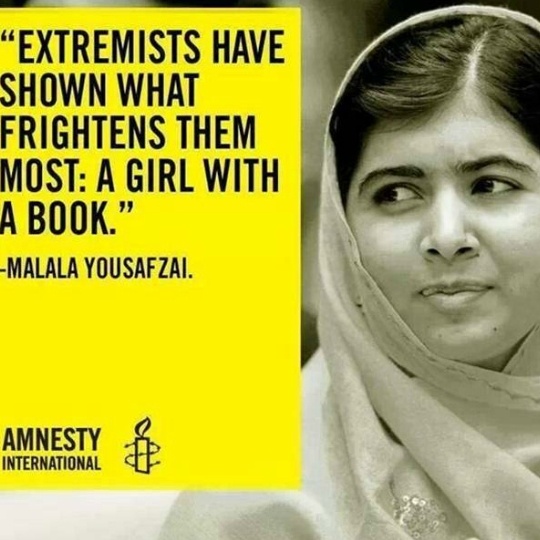
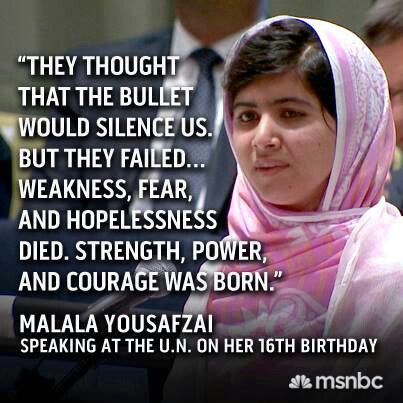
Malala – the girl who was shot for going to school

MalalaQuote-540 malala-amnesty111_1412940157_1412940167_540x540 3f0e3917d2076f20039facf864c14936

After the emotion of the events last week in France this is perhaps a good topic to discuss in class:  Malala Yousafzai the Pakistani activist for female education and the youngest-ever Nobel Prize laureate.

Malala initially came to prominence when, as an 11-year-old, she wrote a diary for BBC Urdu, giving an account of how her school in Mingora town dealt with the Taliban’s 2009 edict to close girls’ schools. In October 2012 she was shot in the head by a Taliban gunman for « promoting secular education ». She recovered from the attack and was even more determined to continue her campaign which is now worldwide. In 2014 she became the youngest person ever to receive the Nobel Peace Prize.  Her love for education, and her courage in standing up to the Taliban, made her an icon of bravery.

Here are a few articles and videos about Malala that can be used to illustrate several notions: myths and heros,  places and forms of power and also the idea of progress.

BBC website : Profile

Malala accepts the Nobel Peace Prize (video)

Ziauddin Yousafzai talking about his daughter and his fight to defend equal opportunities for education (video)

Article and video « Documenting a Pakistani girl’s transformation »

http://www.bbc.co.uk/programmes/p02dz23b

The Christmas Number One

téléchargement

One of the less-well known Christmas traditions in the UK is the countdown to the Christmas « number one »: which song will be number one in the charts for Christmas? It may seem surprising but the British take a great interest in the charts, more so than any other country in the world. This interest has been fuelled by the media – newspapers and magazines publish articles about the « contentenders » for the number one position and TV programmes such as X-Factor finish just before Christmas, giving the winner a good chance of taking the number one position.

Very often several charity records are released just before Christmas to raise money for different causes. For example this year marks the 100th anniversary of the Christmas Day Truce, during World War 1. This event inspired The Farm’s 1990 hit All Together Now and many of the UK’s biggest music stars have united as The Peace Collective, to re-record the song. The new track features a backing choir of schoolboy footballers from the Premier League and German Bundesliga. All profits from the release, will go to the British Red Cross and the Shorncliffe Trust.

Read the article about it here

and watch the video here:

http://www.youtube.com/watch?v=SNmugOpDhW8

Another charity song is the well-known hit « Do they know it’s Christmas? »  a song that was initially written by Bob Geldof and Midge Ure in 1984 to raise money for relief of the famine in Ethiopia. The original version became the biggest selling single in UK Singles Chart history.  The song was re-recorded in 1989 by Band Aid II and in 2004 by Band Aid 20, again raising funds for famine relief.  The song was again re-recorded in 2014 by Band Aid 30, to raise funds for the ongoing Ebola crisis in West Africa.

Do they know it’s Christmas (2014)

Another contender for the number one spot is the song which accompanies the annual John Lewis advert (see also https://anglaispourlebac.com/2013/12/03/john-lewis-christmas-ad-another-christmas-tradition/)

This year it a story about Monty the penguin , and the song is « Real Love » by Tom Odell

http://www.youtube.com/watch?v=iccscUFY860

Article in the Daily Telegraph about the annual John Lewis advert.

Notions that could be linked to this topic

Spaces and exchanges: young German and British footballers coming together to give a message of peace 100 years after the Christmas truce and raise money for charity

Places and forms of power: The power of the media

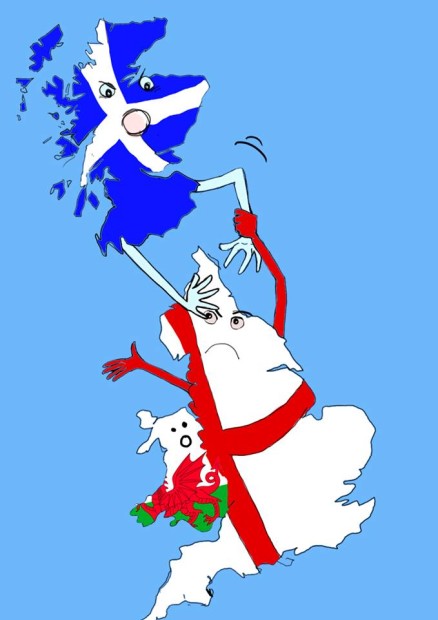
Scottish Independence referendum

1961547_662154397165294_980255488_n-438x620

The Scottish independence referendum takes place on September 18th 2014. The voters will be asked one question: « Should Scotland be an independant country? »

The result of the referendum should be known on the 19th September. Today a poll (sondage) shows the « yes » side in the lead for the first time. Many people still haven’t made up their mind.

Here are a few articles to help you understand more about the Scottish independence referendum:

– a very clear BBC article which explains why the referendum is taking place, what are the arguments « for and against » and the key issues at stake

– a website for resources and views on the referendum

– a pdf to download with the background information

– a video with different opinions for and against :

– 9 reasons why Scotland is better off independant :

– the arguments against Scottish independence :

– Oral comprehension (type BAC)

– What is at stake? (BBC videos)

Do you think that Scotland should become independant?

Definition of Places and Forms of Power (mise à jour février 2014)

Il est souvent difficile de trouver des idées pour illustrer chaque notion. N’oubliez pas que certains sujets peuvent être utilisés pour illustrer 2 ou même 3 notions – prenons comme exemple l’histoire de Rosa Parks:

– (myths et héros) une figure emblematique de la lutte contre la ségrégation raciale aux États-Unis

http://www.sparknotes.com/history/american/civilrights/terms.html

– (lieux et formes de pouvoir) les raisons de la lutte contre la ségrégation raciale aux Etats Unis

– (idée du progrès) – comparaison des conditions de vie des afro-américains pendant les années 60 avec les conditions aujourd’hui (un président noir).

Voici donc quelques idées de sujets pour illustrer la notion « Lieux et formes de pouvoir ».

Places and forms of power

« Places » could be important buildings or institutions that represent a certain form of power, for example Buckingham Palace – a symbol of the British monarchy, the White – a symbol of the American presidency.

A place can also be a country or a state –  for example the USA is a state which is powerful enough to influence events throughout the world (superpower) and China is a major economic power in today’s world.

What exactly is power?

It is the ability to control others, events, or resources; the ability to make things happen despite obstacles, resistance, or opposition. This of course leads to conflict between those who have power and those who don’t.

Resistance to power

There are many examples of resistance to power:

the African-American civil rights movement (Rosa Parks, Martin Luther King Junior, Malcom X….)

Videos to watch:

– Biography of Rosa Parks

Song « Sister Rosa » about Rosa Parks

– Presentation of the characters from the book and film « The Help » (la Couleur des Sentiments):

trailer from the  film « The Butler »

– interesting page with lots of links about the film « The Butler »

the struggle for liberation in South Africa (Apartheid, Nelson Mandela)

the Suffragettes’ fight for women’s right to vote

Video « Bad romance » : a parody music video paying homage to Alice Paul and the generations of brave women who joined together in the fight to pass the 19th Amendment, giving women the right to vote in 1920.

Women’s rights movement in the US

 The ability to influence others

The power of the media

If we look at the power of the media for example we can see how much it can influence the public opinion. The mass media plays an important role in forming our personality, enriching our knowledge, providing us with information of any kind.
Mass media can have an effect on our personal identity: it can help us to feel that we are part of a group (social networks) but on the other hand it can contribute to a feeling of isolation.

Media can have a strong political influence or can shape the way we perceive certain groups of society – minority groups, pressure groups…mass media is powerful because it makes us believe what is acceptable and unacceptable behaviour (reality TV).

However it can also have harmful impact on society:

– On-screen violence leading to actual violence (violent video games/films)

– Identity or financial fraud on the internet people to fraud, especially identity fraud.

– the dangers for children who are able to access Internet material inappropriate for their age.

– The Internet can facilitate an invasion of privacy – (chat rooms, social networks, bullying)

Economic and political power

– The European Union – past, present and future

– the « superpowers » ( states with a dominant position in the international system with the ability to influence events and its own interests and project power on a worldwide scale to protect those interests – e.g. USA)

– emerging countries (Brazil, Russia, India and China, are now playing an increasingly important role in the global economy, with this group of four powerful developing economies sometimes referred to as the BRIC countries)

The power of guns

– The debate on gun control in the USA

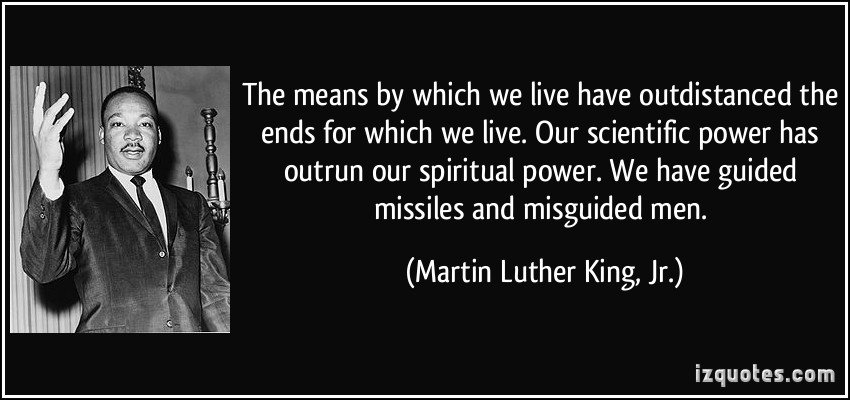
Finally an interesting quote to illustrate this notion:

quote-the-means-by-which-we-live-have-outdistanced-the-ends-for-which-we-live-our-scientific-power-has-martin-luther-king-jr-102519

Places and forms of power: Queen Elizabeth II

Royal visit to Hertfordshire

Her Majesty the Queen

Elizabeth II

Queen Elizabeth II was  born on 21 April 1926. Today she is Queen of sixteen countries throughout the world: the United Kingdom, Canada, Australia, New Zealand, Jamaica, Barbados, the Bahamas, Grenada, Papua New Guinea, the Solomon Islands, Tuvalu, Saint Lucia, Saint Vincent and the Grenadines, Antigua and Barbuda, Belize, and Saint Kitts and Nevis. She is the queen of each country separately, and all sixteen are independent countries. She became Queen when her father, King George VI, died on 6 February 1952.

The countries of which she is Queen are known as Commonwealth realms. Their total population is over 129 million. Elizabeth II lives in the United Kingdom. In all the other countries where she is queen, a person has been chosen to represent her. This person is known as the Governor General.

Elizabeth II is Queen and is interested in the running of her countries, but she does not tell the governments what to do. She has regular meetings with people from her governments, but it is they who run the countries. She performs ceremonies for the governments, gives out honours, and visits and supports many charities.

Since 1947, the Queen has been married to Prince Philip, Duke of Edinburgh. Prince Philip was born into the royal families of Greece and Denmark. Just before they were married, he became a citizen of the United Kingdom, and changed his name to Philip Mountbatten. He became the Duke of Edinburgh on the day he married, and became a Prince of the United Kingdom in 1957. The Queen and Prince Philip have four children, eight grandchildren and three great-grandchildren.

Source: Simple English Wikipedia

Here are a few links to learn more about Queen Elizabeth:

An exclusive interview with the Queen: video

10 things you didn’t know about the Queen: video

Nelson Mandela : one of the most inspiring figures of the 20th century

OBIT_NelsonMandela_1918_2013_131205_16x9_992

Nelson Mandela 1918-2013

 Rolihlahla Mandela was born in Transkei, South Africa on 18 July 1918 and was given the name of Nelson by one of his teachers. His father Henry was a respected advisor to the Thembu royal family.

ANC involvement

Mandela was educated at the University of Fort Hare and later at the University of Witwatersrand, he qualified in law in 1942. He became increasingly involved with the African National Congress (ANC), a multi-racial nationalist movement trying to bring about political change in South Africa.

In 1948, the National Party came to power and began to implement a policy of ‘apartheid’, or forced segregation on the basis of race. The ANC carried out a campaign of passive resistance against apartheid laws.

In 1952, Mandela became one of the ANC’s deputy presidents. By the late 1950s, faced with increasing government discrimination, Mandela, his friend Oliver Tambo and others began to move the ANC in a more radical direction. In 1956, Mandela went on trial for treason. The court case lasted five years, and finally Mandela was acquitted.

In March 1960, 69 black anti-apartheid demonstrators were killed by police at Sharpeville. The government declared a state of emergency and banned the ANC. In response, the organisation abandoned its policy of non-violence and Mandela helped establish the ANC’s military wing ‘Umkhonto we Sizwe’ or ‘The Spear of the Nation’. He was appointed its commander-in-chief and travelled abroad to receive military training and to find support for the ANC. On his return he was arrested and sentenced to five years in prison. In 1963, Mandela and other ANC leaders were tried for plotting to overthrow the government by violence. The following year Mandela was sentenced to life imprisonment. He was held in Robben Island prison, off the coast of Cape Town, and later in Pollsmoor Prison on the mainland. During his years in prison he became an international symbol of resistance to apartheid.

In 1990, the South African government responded to internal and international pressure and released Mandela, at the same time lifting the ban against the ANC. In 1991 Mandela became the ANC’s leader.

He was awarded the Nobel Peace Prize together with FW de Klerk, then president of South Africa, in 1993. The following year South Africa held its first multi-racial election and Mandela was elected its first black president.

In 1998, he was married for the third time to Graça Machel, the widow of the president of Mozambique. Mandela’s second wife, Winnie, whom he married in 1958 and divorced in 1996, remains a controversial anti-apartheid activist.

In 1997 he stepped down as ANC leader and in 1999 his presidency of South Africa came to an end.

In 2004, Mandela announced his retirement from public life, although his charitable work continued. On 29 August 2007, a permanent statue to him was unveiled in Parliament Square, London.

He died on 5 December 2013, aged 95.

To learn more about Nelson Mandela’s life you can visit these pages:

– Watch the video on the BBC Website: Obituary

– Watch the video on the Guardian newspaper website: http://www.telegraph.co.uk/news/worldnews/nelson-mandela/8286419/Nelson-Mandela-obituary-part-one-one-of-the-most-inspiring-figures-of-the-20th-century.html

– Learn about the timeline of Mandela’s life with videos : BBC News

– Learn some of Mandela’s popular quotes

– Watch the video on the History channel

– How would Mandela have used social media if it has existed? Watch the Video here – thank you to http://www.teachermanigat.com/ for the link!

To learn more about apartheid:

– You can visit the excellent Apartheid museum website

To improve your listening comprehension :

– Online exercises here

To improve your reading comprehension:

– Learn all about Mandela and apartheid here

Tips for your oral presentation!

Do you consider Nelson Mandela to be a modern-day hero? What has he achieved for black South Africans? How has their life become better today? Does this make him a hero?This topic can not only illustrate the notion of myths and heroes but also the idea of progress: after racial segregation during colonial times in South Africa, the struggle that led to the abolition of apartheid has brought about a great number of changes for the black population.Finally this topic could be the perfect illustration for the notion of places and forms of power:

Apartheid caused significant internal resistance and violence, and a long arms and trade embargo against South Africa. There were many uprisings and protests leading to  the imprisoning of anti-apartheid leaders. As unrest spread and became more effective and militarised, state organisations responded with repression and violence. Along with the sanctions placed on South Africa by the international community, this made it increasingly difficult for the government to maintain the regime. Apartheid reforms in the 1980s failed to stop the mounting opposition, and in 1990 President de Klerk began negotiations to end apartheid. There were multi-racial democratic elections in 1994 that were won by the African National Congress under Nelson Mandela.

Comment définir les quatre notions?

La définition des 4 notions

1. Myths and heroes:

A myth can be defined as a story about gods or heroes, it can be a popular belief or a tradition or a false notion. A hero can be a mythological figure, a person who is admired for his or her achievements, a superhero or maybe a role model or an icon.

 Examples can be:

– a patriotic or national hero (sportsman, politician, human rights defender…..)

– a fictitious hero (superhero or film star)

– an icon or role model (fashion, tv, music)

– a defender of common values

– a politician/king/queen who has achieved international recognition

2.  Locations and forms of power: (also called Places and forms of power or Seats and forms of power)

In politics and social science, power is the ability to influence the behavior of people. In order to live together members of a community accept rules, regulations, laws. This helps to create social cohesion but can also lead to conflicts and tensions. Even when authority seems absolute, there are always counter-powers which question it, aim at limiting its excesses and resist it.

 Examples can be:

– the power of the media (reality tv, internet v written press)

– Financial power (the power of money)

– Inequalities between blacks and whites – the fight against oppression and segregation (South Africa, USA)

– The American Dream

– The Civil Rights movement and political recognition : Rosa Parks, Martin Luther King, Malcolm X (can also be linked to the notion of Myths and Heroes)

3. The idea of Progress

The idea of progress can be defined as an improvement, a development or a change – a technical, scientific or social advance which contributes to making the world a better place.

 Examples can be:

– Scientific Progress – Medical advances, cures for illnesses, cloning, performance enhancing drugs,   genetically modified organisms.

– Technological Progress-  technologies to slow down climate change such as hybrid cars, wind turbines, solar panels, biofuel…..

advances in communication:  the internet, social media, mobile phones, video games – how      they have changed our lives and the dangers of these modern ways of communication

Robots, automated production

Nuclear Power – for and against

–  Social Progress: changes in the quality of life – how does progress affect our society?

Education, employment, equality, family life

Women’s rights, human rights, minority rights ……

The idea of liberty, freedom, democracy

 4. Spaces and Exchanges

This notion deals with the geographical and symbolic areas that all societies occupy and the interactions between men and different societies. Our world is built on the exploration and conquest of new spaces. The different cultural, economic, sociological and language interactions have shaped and characterised our modern-day world.

 Examples can be:

– Trade (the basis of all societies)

– Working conditions (telecommuting, internet)

– Globalization (the world has become a small village)

– School and education (social diversity / knowledge)  comparison of the different educational systems

– The Internet / social networks…

– the movement of people: Immigration

– movement across borders (Gap Year)

Pour plus d’informations vous pouvez consulter les pages suivantes:

http://missions.editions-bordas.fr/enseignant/webfm_send/108

Learn all about London – and maybe win a trip!

« London Story »

London is a fascinating place and the people that live and work there have many interesting stories to tell.

Here is the link to the competition:

http://www.visitlondon.com/story/competition

You can then click on the different stories told by Londoners, choose your 3 favourite videos and then submit your choices. You may win an all-expenses-paid trip to London.

If you don’t win, it’s an excellent way of learning about the different monuments and places to visit in London.

Do you want to learn about the making of Harry Potter films? Watch this video: http://www.visitlondon.com/story/profile/23035130-warner-bros-studio-tour-london-the-making-of-harry-potter

Do you want to learn about the different types of transport in London? Watch this video http://www.visitlondon.com/story/profile/33177689-transport-for-london

What about the Tate Modern Museum? Watch this video: http://www.visitlondon.com/story/profile/344410-tate-modern

And have you heard about Madame Tussauds? Watch this video about Rebecca who is an artist at Madame Tussauds and who talks about the history of the museum http://www.visitlondon.com/story/profile/284875-madame-tussauds-london

And for all football fans what about learning all about Wembley Stadium? http://www.visitlondon.com/story/profile/4114851-wembley-stadium-tour

It is an excellent way to learn all about London and the history of the different monuments!  And also excellent practice for the listening comprehension part of your exam!

Enjoy!!!


Les Présidents Américains

usa-map-american-presidents-23336415


Diaporama des « dix meilleurs » Présidents américains selon le journal le Parisien

Learn about Presidential fun facts here: http://www.history.com/topics/the-us-presidents/videos#presidential-fun-facts

Other interesting facts about american Presidents here: http://www.history.com/topics/the-us-presidents/videos#founding-fathers-of-innovation

Learn about the White House here: http://www.history.com/topics/the-us-presidents/videos#deconstructing-history-white-house

Find out detailed information about each President here: http://www.usa4kids.com/presidents/Presidents.html